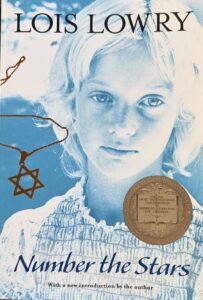
 Number the Stars by Lois Lowry stands the test of time. Readers may think I have lived under a rock, but I wasn’t well-acquainted with Lois Lowry’s works until I attended a presentation she gave recently in Phoenix. I knew of her, just not much about her, since children’s books aren’t a genre I read. The Phoenix Holocaust Association hosted an author event with Lowry, timed with International Holocaust Remembrance Day. I’m so glad they did, and I’m so glad I went.
Lois Lowry writes for young audiences
Lowry’s first book, A Summer to Die, was published in 1977, when I was in college, busy typing term papers and struggling to pass Chemistry 101. Her most famous book, The Giver, came out in 1993, when I had three small children and worked full-time. During those years, I barely had bandwith to read a magazine article or two, let alone luxuriate quietly by myself with a novel. They were good years, but younger grade novels didn’t appear on my literary radar.
I listened to the audiobook edition of Number the Stars last week. Count me a fan. This book is storytelling brilliance in 132 pages. It is written for ten-year-old readers and views the Holocaust in Denmark in 1943 through the eyes of ten-year-old Annemarie Johansen. As the back cover states, “In this tale of an entire nation’s heroism, the story of the Danish Resistance and their plan to smuggle the entire Jewish population of Denmark – nearly seven thousand people – across the sea to Sweden is told with pride and hope through one young girl’s eyes.” Besides being a great writer, I respect that she stayed true to history and did her research. She estimates she spent a year writing the book to get it right.
“I learned from your book that being brave doesn’t mean you’re not scared, but that you are facing your fears to do something right.” – Excerpt from a letter to Lois Lowry from a young reader in response to Number the Stars
The Daring rescue of Denmark’s Jews in October 1943
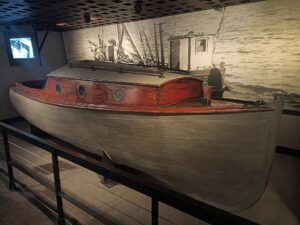
Denmark was and is a small country, located immediately north of Germany. In 1939 the population was less than four million people. At the outset of the war, Denmark declared neutrality. Still, the Germans invaded Denmark in April of 1940. Outgunned and outmanned, King Christian did not oppose the Germans, and took a more cooperative stance, hoping to win concessions for Denmark. The Danish government continued to function. German soldiers appeared on the streets, but life didn’t change as drastically as in other countries the Germans invaded and took over. All that changed in August 1943 when the Germans imposed martial law, dissolved the Danish government and began to plan actions against the country’s small Jewish population.
German police were therefore brought to Denmark. But Danish politicians, and a German official, Georg F. Duckwitz, warned the Jewish community in Copenhagen a few days before the planned actions. Conditions in Denmark helped
“I am a grandmother now. For my own grandchildren – and for all those of their generation – I try, through writing, to convey my passionate awareness that we live intertwined on this planet and that our future depends upon our caring more, and doing more, for one another.” – Lois Lowry
Lois Lowry rocks. Count me a fan
Lois Lowry rocks as a person and as a storyteller. She turns 90 years old in two months and has a new book coming out in April. It’s even more impressive that she brings the energy of someone fifteen years younger to stand and give two successive, well-executed presentations. She married young, had four children, and didn’t publish her first book until the age of forty. Today, she has written more than forty books and has won the Newbery Medal twice, for The Giver in 1994, and Number the Stars in 1990. The Giver has sold more than twelve million copies worldwide, and Number the Stars has sold more than two million copies. Both have been widely translated.
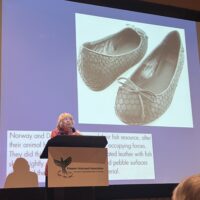
While The Giver was a dystopian novel, I respect how true the author stayed to actual history in Number the Stars. She incorporated stories of the Danish king, the Resistance, and two other lesser-known true stories. Creative Danes used fish scales to make shoes when there was no leather. And the fishermen used a ruse to throw off German dogs. Swedish scientists devised a powder composed of dried rabbit’s blood and cocaine. The blood attracted the dogs, and when they sniffed at it, the cocaine numbed their noses and temporarily destroyed their sense of smell. The fishermen used this concoction
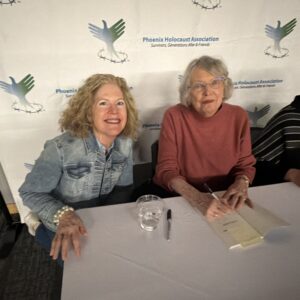
After the talk, I got a picture with Lowry. She’s down to earth, witty, and the kind of person you sense you could sit on her porch, share a cup of tea, and talk for hours and never get bored. I’m sure any discussion with Lowry will also make you think.
“Kids deserve the right to think that they can change the world.”
—Lois Lowry
Resources:
Lois Lowry website: https://loislowry.com/
Holocaust Encyclopedia, Rescue in Denmark: https://encyclopedia.ushmm.org/content/en/article/rescue-in-denmark (There are lots of resources and references out there about the Danish resistance.)
Phoenix Holocaust Association: https://phxha.com/
In friendship and gratitude,
Katrina